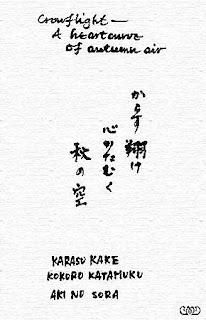
In my first few years in Japan, I spent most of the time apart from in the winters, travelling the length and breadth of the country by motorcycle, living in a tent in the forests, taking photographs and writing poetry. My girlfriend at the time was Fukiko Hayamizu, who translated them for me and did the Japanese calligraphy for the poems collected below. Her translations were so good and idiomatic that many Japanese assumed they were the originals and that the English versions were translations of them, whereas the reverse was of course the case.
Showing posts with label CMC WRITINGS. Show all posts
Saturday, January 25, 2020
Saturday, July 06, 2019
Remembering Jeffrey Tate
In my first year at Cambridge there was a small group of friends, all fellow members of Christ's College, who met together most evenings and many afternoons for endless conversation. What we all had in common was a great appreciation of classical music, theatre and of wit. Jeffrey was a powerhouse of all these. His physical affliction ruled out most roles in drama, but his direction/production of Measure For Measure for the ADC (or Mummers? or Marlowe Society?) left an indelible impression on me.
In those days, despite never having had any piano lessons, I was trying to teach myself to play Bach.The second piece I learned was Var.13 of the Goldberg Variations. It took me two years. I used to practice it in a little back room at Christ's One day Jeffrey popped in to see what I was doing.
"Do you play?" I asked.
"A little," said he.
"Please show me how this should go"
"A little," said he.
"Please show me how this should go"
Whereupon he sat down and played it so well that I asked him to start from the beginning, and marveled as he sightread the entire Goldberg Variations, his performance being as good as any I had heard. I knew he loved music and was in the college choir, but he was studying medicine, so it was quite a surprise. But in fact, after doing his medical internship, he got a position as a repetiteur for Georg Solti at Covent Garden, and went on to become principal conductor at Covent Garden, the English Chamber Orchestra, the Rotterdam Philharmonic.and others.
I lost touch with him when I left England for India and, eventually, Japan, but he got in touch when he came to Tokyo for some concerts with the pianist Mitsuko Uchida, and my wife and daughter and I attended the concert and spent the rest of the day with the two of them; he was as fun to talk with as ever,and we were able to catch up a bit on what had become of all the members of our little clique.
Although people with his condition normally have a short life expectancy, this didn't seem to apply to Jeffrey. You may have noticed that conductors generally live to a very advanced age, often doing their best work in their final decades. I don't for a moment doubt that allowing music to flow continually through your mind and body is the closest thing to the Elixir Of Youth available And also, as Jeffrey said,
""There is in the last resort no limit to my physical energy if I know what I'm doing and want to do it."
Saturday, June 15, 2019
An introduction to EarthlingZ, the creative community that has grown up around the site in the mountains where my wife Futaba and I settled a few decades ago:
GreetingZ, EarthlingZ!
Most of you know about and many of you have visited The
Greenhouse and Silkhouse , which constitute the physical
basecamp of EarthlingZ in the mountains of Chichibu. It
is a couple of old farmhouses which we have turned into a
place catering to the creative and nature-oriented people
we have come to know through our own activities,
especially those working in the fields of music, dance,
graphics, the healing arts, and the spiritual sciences.
Greenhouse and Silkhouse , which constitute the physical
basecamp of EarthlingZ in the mountains of Chichibu. It
is a couple of old farmhouses which we have turned into a
place catering to the creative and nature-oriented people
we have come to know through our own activities,
especially those working in the fields of music, dance,
graphics, the healing arts, and the spiritual sciences.
Of course there are countless such people, especially in
and around Tokyo, but our location and the values we
encourage has meant that only those who have discovered
the importance to their creativity of connecting with the
infinite energies of organic Nature will make the effort
to return again and again.
and around Tokyo, but our location and the values we
encourage has meant that only those who have discovered
the importance to their creativity of connecting with the
infinite energies of organic Nature will make the effort
to return again and again.
There is very little in urban life today that brings to
our attention our place in the cosmos, or even reminds us
that we are on an actual planet. From the moment we leave
our rooms in the morning we are moving through a creation
of human engineering, a giant warehouse and database
which we navigate in as straight lines as we can towards
destinations determined largely by our material agendas.
our attention our place in the cosmos, or even reminds us
that we are on an actual planet. From the moment we leave
our rooms in the morning we are moving through a creation
of human engineering, a giant warehouse and database
which we navigate in as straight lines as we can towards
destinations determined largely by our material agendas.
We rarely look up, knowing that there will be no stars
visible, and that what's happening in the sky makes
little difference to our work and movements. Even as we
sleep we are bathed in the discordant electromagnetic and
psychic vibrations of the physical and mental activities
of millions, but hardly understand the tensions and
levels of egotism this creates.
visible, and that what's happening in the sky makes
little difference to our work and movements. Even as we
sleep we are bathed in the discordant electromagnetic and
psychic vibrations of the physical and mental activities
of millions, but hardly understand the tensions and
levels of egotism this creates.
If we step out of this and into the real life of the
planet, we find our oppressive sense of separate selfhood
dissolve as we walk through the cool cathedrals of the
cedars, watch the wind ripple over the ricefields, or
hear the voices of birds and animals punctuate the
stillness of the glittering night.
planet, we find our oppressive sense of separate selfhood
dissolve as we walk through the cool cathedrals of the
cedars, watch the wind ripple over the ricefields, or
hear the voices of birds and animals punctuate the
stillness of the glittering night.
In such an atmosphere, we need no guidance, no teachers
or gurus, to bring us to considering our condition as
humans on the earth. We move without effort towards
wider perspectives, consider our pasts and futures with
at least temporary detachment, and recharge our spiritual
batteries through grounding to the earth while attending
to the heights.
or gurus, to bring us to considering our condition as
humans on the earth. We move without effort towards
wider perspectives, consider our pasts and futures with
at least temporary detachment, and recharge our spiritual
batteries through grounding to the earth while attending
to the heights.
This often leads us to make music, to dance, to centre in
the Here and Now, to show each other the wonders we
discover in so doing, and to rediscover what marvellous
creatures human beings are when they are really Present
and open to each other and their environment.
the Here and Now, to show each other the wonders we
discover in so doing, and to rediscover what marvellous
creatures human beings are when they are really Present
and open to each other and their environment.
It was once said by Terence McKenna that "Nature is the
great teacher of metaphysics". People who like to learn
this way we call EarthlingZ, and all the facilities we
have developed here are meant to make this easier.
great teacher of metaphysics". People who like to learn
this way we call EarthlingZ, and all the facilities we
have developed here are meant to make this easier.
Saturday, September 08, 2018
Memories of Nigel and Jenny
A writer named Ingrid Maclean is writing a book about the psychedelic revolution in London in the 1960s, of which a large part will be the story of the adventures of my good friend Nigel Lesmoir-Gordon, and I was asked to contribute some reminiscences,. I procrastinated until the deadline was upon me, and quickly penned this the other evening.
-----------------------------------------------------------------------------------------------------------------------------------------
By the time I went to Cambridge to study philosophy, I had been devoted to literature for years, and even intended to be a writer, having been producing poetry since I was 13. It was in literature, of all the creative arts, that I sought to learn about human nature and existence. I had thought that the study of philosophy would amount to considering such matters at an even higher level than poetry, but I had the misfortune to be at university in a period when British philosophy was dominated by logical positivism, which rejected all metaphysical notions as well as existentialism ("continental claptrap", opined my director of studies.)
Disillusioned with the courses and lecturers, I found myself devoting much more time and attention to drama, which at least seemed to be concerned with The Meaning Of Life. But I soon came to find the theatre world at Cambridge to be much more petty and cliquey than suited me. I had previously in London been involved with the Hampstead bohemian set, and came to know similar people in Cambridge, some of whom lived in a house in Clarendon St. owned by a recent graduate, Bill Barlow.
It was in a conversation with Bill that he made what seemed to me the radical assertion that my goal of being a creative person was not necessarily the most admirable path. Rather, he insisted, the elevation of consciousness was the greater priority. After all, the quality of one's creative work is bound to be a direct result of one's consciousness, and the most important criterion of its value was surely its effect on the consciousness of others as well.
Nigel Lesmoir-Gordon at that time was living at Clarendon St., and I soon realised that he was already of that persuasion, and it was from him that I learned about such authors as Ouspensky, whose Meetings With Remarkable Men and Tertium Organum were fundamental texts for the expanded consciousness movement, as well as Gurdjieff and R.D. Laing, who was making waves with his novel ideas about altered mental states. Nigel was quite familiar with the beatniks, and introduced me to many of their writings. I soon was spending more time at Clarendon St. than with my fellow students, delighting in conversation with Nigel and his lovely girlfriend,later wife, Jenny.
At about the same time that I left the university in 1965, Nigel and Jenny moved to an apartment in London, also owned by Bill Barlow, at 101 Cromwell Road. Once again I was drawn to their company time and again, and after living for a few months in Marylebone, I moved in to the room next door to theirs. Thus began the most intensely transformative period of my life to date. It's hard to believe that it really only spanned about three years, so full of experience and realisations was it. The history of 101 is well-known; the myriad of underground writers, artists, musicians and psychonauts who frequented the place has become legendary. Nigel was the most congenial of hosts, and Jenny brought a cleverly mischievous charm to all occasions, and there was hardly an evening when there were not several or many visitors, quite often enjoying the LSD that arrived there via Michael Hollingshead and John Esam before it was known at all in London.
Many histories of the 60s present the 101 scene as if it revolved around Syd Barrett of the Pink Floyd, who lived there at various periods, and perpetuate the perspective typical of journalists and fans, namely that the most famous person in a group is the centre of it, implying that the people sharing space with him at 101 Cromwell Road and later at Egerton Court were "camp-followers" or "hangers-on." Nothing could be farther from the truth. Just about everybody there had his own thing; most were there before he came, and some of them were his childhood friends. The creative atmosphere owed less to him than to such residents as Nigel, poet John Esam (who co-organised the Albert Hall Poetry Festival), photographer Dave Larcher, graphic artists Storm Thorgerson and and the others who formed Hipgnosis, visual artist David Gale (Lumiere & Son), poet-author of The Book of Grass George Andrews, budding alchemist Stash Klossowski de Rola, etc., etc. Other visitors to 101 included Allen Ginsberg, William Burroughs, Kenneth Anger, Donovan, Marianne Faithfull, Alex Trocchi, and various Stones and Beatles. A much longer list could be made, but the point is that Syd was there because it was a matrix from which sprang the 60s London psychedelia. Of course, in addition to the psychonauts there were people who came merely because it was a Scene, people stuck at the level of personalities. Interestingly enough, many of these are the ones most eager to be interviewed about the carryings-on there, and their accounts often miss the essence as much as they themselves missed the point then through their exclusive focus on personalities.
At that time I was working as assistant to Robert Fraser (Groovy Bob) at his gallery in Duke St., which became one of the principal nodes of Swinging London. Through Fraser I met and became good friends with Christopher Gibbs, the two of them being central figures in a bohemian aristocrat set to which several Rolling Stones and Beatles were also attracted. I introduced Nigel to these people, and he and Jenny were immediately accepted with great enthusiasm. After all, few couples merited the term "The Beautiful People" as much as they did, and many of these privileged people and celebrities were becoming turned on to acid and welcomed the transcendental perspective that we sought to share, which interpreted the psychedelic experience as cognate to the experiences of mystics and occultists.
At that time there were basically two schools of thought about how LSD was best taken, which one might call the Leary school and the Kesey school. The latter, with its extroverted antics and missionary zeal, is well described in Tom Wolfe's Electric Koolaid Acid Test. The Leary/Alpert approach was based on eastern spirituality, though no less proselytising. Nigel, like most of us, was of that leaning, and our explorations of Buddhism, Taoism, Jung's writings and many other esoteric works gradually led many of us to a search for the ideal method of attaining what we were still bold enough to call Enlightenment.
It was in the company of Nigel and Jenny that my transition to vegetarianism began. While full-on tripping,we went to a restaurant and ordered a meal. When it came, I stared at my veal escalope in horror, muttering "Baby calf flesh", while Jenny gazed in dismay at her omelette. "Baby chickens,", I believe she whimpered. I can't remember what Nigel had ordered, but that experience pretty much converted me to a vegetarian diet. It was at another restaurant meal, incidentally, that I placed in a moment of verbal ineptitude an order for "a glass of two milks", a phrase that will live in infamy, now that Nigel has used it as the title of one of his recent novels.
It was from Nigel that I first learned about a Master in India who seemed to have all the qualities of a true master, as distinct from the many questionable gurus who appear in profusion, levitating, collecting Rolls Royces and materialising watches, etc. Several friends had been to his ashram, or Dera as it was called, and came back with glowing testimony to his being The Real Thing. It was not long, therefore, before Nigel and Jenny, myself and Adrian Haggard obtained permission to attend the Radha Soami Satsang in Beas, Punjab. Adrian and I set out to hitchhike to the Punjab, which was an adventure in itself, and we met up with Nigel and Jenny there. Over the next few weeks we experienced the amazing aura and wisdom of the master, Charan Singh, and as our stay there ended, we all received initiation into the practice of Shabad Yoga, the yoga of internal sound. Without doubt this has proven the most significant turning point in all our lives.
Nigel and Jenny returned to England, and I headed east, hitchhiking and working my way on ships until I reached Japan, where I have been pretty much ever since. We've got together several times over the years, in England and in India, and they remain among the most loved people in my life, true spiritual colleagues. Many of my best memories are of things said or written or otherwise learned from or together with them. If any one thing epitomises the shared vision we had from the start of what we might become, it is probably a Chinese poem Nigel had written out and pinned to his wall, which seemed to sum up the ultimate goal as not at all the gravitas of Enlightenment, but the shared delight of heightened awareness.
"When two masters meet
They laugh and laugh--
The trees, the many fallen leaves."
They laugh and laugh--
The trees, the many fallen leaves."
Labels:
ANECDOTES / QUIPS,
BIOGRAPHY,
CMC WRITINGS,
PERSONAL
Tuesday, July 19, 2016
To Write Or Not To Write?
I have often contemplated, and even been urged, to write an
autobiography, but have consistently postponed it until such time as I
can't do much else, such as when my emphysema will reach a point where I
sit around and search the web for cheap oxygen canisters.
But it's more than that. It seems to me that to be worth foisting onto other people with a "Please read and review this". it would have to be more than a sequence of anecdotes and name droppings. It would have to approximate the concept of Bildungs Roman, of which the novels of Hermann Hesse are a clear example; a tale of the gradually evolving consciousness of a person. Anecdotes would have to mark moments of realisation, not necessarily entheogenic, but of the nature of humans and the general question of WTFIGO. But I suspect that I'm not interesting enough as a character or mind for the story of How I Became What I Am to be worth the effort, especially as age tends to bring with it the realisation not only that "Vanity of vanities; all is vanity", but that Life Is Not A Story, and that casting it in the form of one ensures that, as Glenn Gould said or implied, autobiography is definitely a subgenre of imaginative fiction, placing in mind-created timespace what really takes place in an eternal Now. I would be inclined to balance that by showing some continuity between the various disillusionments that determined changes in direction and perspective, featuring the recurrent (and to me welcome) realisation that everything I hitherto believed was wrong (or should I say "wrnog"?).
It could be entertaining if I described some of my Meetings With Remarkable People or friendships with celebrities and the rich, but mainly in how for the most part such experiences cured me of interest in fame, fortune and ambition. I fear it might be something of a downer for the reader, though, as I would have to chronicle how an entire generation in America and parts of Europe felt like outsiders in the 60s and created the so-called counterculture, with the vast majority of them gradually morphing into the Me Generation, learning to mock people such as myself, who don't see it as moving on from naive idealism to Being Realistic to hold, for example, that it actually makes more sense even from a hardcore empirical perspective to hug a tree than to cut it down for garden furniture or artisanal firewood. ( I recall in childhood being repelled by watching fish die in the bottom of the boat, and feeling something was wrong when I learned that my uncle's waterskis, which I so enjoyed using on Lake Winnepesaukee, were made from a giant redwood. (It's probably good to get an early start to accepting you're a weirdo.))
Writing an autobiography would, of course, provide ample excuse for the type of rambling you see above, and would doubtless lead to vast swathes of nested parentheses....
But it's more than that. It seems to me that to be worth foisting onto other people with a "Please read and review this". it would have to be more than a sequence of anecdotes and name droppings. It would have to approximate the concept of Bildungs Roman, of which the novels of Hermann Hesse are a clear example; a tale of the gradually evolving consciousness of a person. Anecdotes would have to mark moments of realisation, not necessarily entheogenic, but of the nature of humans and the general question of WTFIGO. But I suspect that I'm not interesting enough as a character or mind for the story of How I Became What I Am to be worth the effort, especially as age tends to bring with it the realisation not only that "Vanity of vanities; all is vanity", but that Life Is Not A Story, and that casting it in the form of one ensures that, as Glenn Gould said or implied, autobiography is definitely a subgenre of imaginative fiction, placing in mind-created timespace what really takes place in an eternal Now. I would be inclined to balance that by showing some continuity between the various disillusionments that determined changes in direction and perspective, featuring the recurrent (and to me welcome) realisation that everything I hitherto believed was wrong (or should I say "wrnog"?).
It could be entertaining if I described some of my Meetings With Remarkable People or friendships with celebrities and the rich, but mainly in how for the most part such experiences cured me of interest in fame, fortune and ambition. I fear it might be something of a downer for the reader, though, as I would have to chronicle how an entire generation in America and parts of Europe felt like outsiders in the 60s and created the so-called counterculture, with the vast majority of them gradually morphing into the Me Generation, learning to mock people such as myself, who don't see it as moving on from naive idealism to Being Realistic to hold, for example, that it actually makes more sense even from a hardcore empirical perspective to hug a tree than to cut it down for garden furniture or artisanal firewood. ( I recall in childhood being repelled by watching fish die in the bottom of the boat, and feeling something was wrong when I learned that my uncle's waterskis, which I so enjoyed using on Lake Winnepesaukee, were made from a giant redwood. (It's probably good to get an early start to accepting you're a weirdo.))
Writing an autobiography would, of course, provide ample excuse for the type of rambling you see above, and would doubtless lead to vast swathes of nested parentheses....
Saturday, December 20, 2014
Syd Barrett and 101 Cromwell Road
I
had forgotten about this posting I made in 2002 to the 604 mailing list
in response to one Clayton Hill's comments on an article in the
Guardian about Syd Barrett, but record producer Shahar just sent it to
me, having archived that list...
Clayton Hill wrote:
Pretty gross, this glorification of an inconsequential blip in the history of Psychedelia. I don't think that Syd had all that much to do with the "Floyd" that most have come to know and love (Meddle onwards). I also don't think that he warrants this hero worship or pity, as he seems to have chosen this for himself, and would prefer NOT to be written thusly into history books and culture. As "brilliant" as Syd and his times may have been, articles like this only deepen the twisted legends and mythologies that are unproductive and unrepresentative of a culture, at best.
______________________
Chris Case wrote:
It could be argued that legends and mythologies are in fact among the most representative aspects of a culture. As for "unproductive", that is hardly a relevant criterion, despite the modern obsession with Productivity. Nevertheless, it is certain that Syd was the inspiration -- the soul, if you will -- of the Pink Floyd, which in turn influenced and inspired many of the artists who now do likewise for many in the current wave. Mythologically speaking, Syd has been inducted into the pantheon as an instance of the archetype "Poete Maudit", updating in a way the Rimbaud archetype.
That said, the article does perpetuate the perspective typical of journalists and fans, namely that the most famous person in a group is the centre of it, implying that the people sharing space with him at 101 Cromwell Road and later at Egerton Court were "camp-followers" or "hangers-on." Nothing could be farther from the truth. Just about everybody there had his own thing, most were there before he came, and some of them his childhood friends. The creative atmosphere owed less to him than to such residents as poet John Esam (who co-organised the Albert Hall Poetry Festival), filmmaker Nigel Lesmoir-Gordon (now producing great films about fractals, Mandelbrot, mathematics, etc.), photographer Dave Larcher, graphic artists Storm Thorgerson and and the others who formed Hipgnosis, visual artist Dave Gale (Lumiere & Son), poet-author of The Book of Grass George Andrews, budding alchemist Stanislas Klossowski de Rola, etc., etc. Other visitors to 101 included Allen Ginsberg, William Burroughs, Kenneth Anger, Alex Trocchi, and various Stones and Beatles. I could make a list twice as long, but the point is that Syd was there because it was one focal point of the matrix from which sprang 60s London psychedelia.
Of course, in addition to the psychonauts there were people who came merely because it was a Scene, people stuck at the level of personalities. Interestingly enough, many of these are the ones most eager to be interviewed about the carryings-on there, and their accounts often miss the essence as much as they themselves missed the point at the time through their exclusive focus on personalities.
Syd was our holy fool for a time, though by no means the best poet among us, and, as things started to go bad, the recipient of vast amounts of protective concern. Unfortunately, none of us could without hypocrisy advise him to stop taking acid completely, but the efforts made to chill him out (I found Bach's Well-Tempered Klavier and St. Matthew Passion particularly effective) and rescue him repeatedly from his own flakiness were such that it is way off the mark to call this circle "fairweather friends". If anyone abandoned him, I'd say it was Roger, and his feelings of guilt permeate the Floyd's subsequent work ad nauseam. Had the friends who tried to introduce him to the therapeutic and harmonising effects of Shabad Yoga (yoga of cosmic sound) been more successful, he might have emerged from this episode as purged as many others of us did, but they certainly got no help from Roger, whose oafish dismissal of mysticism in favour of a middleclass version of surly "working-class hero" resentment gradually moved the Floyd's weltanshauung from Syd's sensitivity to English game-reality and from his whimsical symbology into schizoid antisocial ranting, culminating in "The Wall", or perhaps in an account at Coutts. Great stuff occurred along the way, I admit, but on the whole the Floyd betrayed the original vision and went down a profitable cul-de-sac, much as the "More is More" crowd of performers are doing today in the trance world.
_________________________________________
Clayton Hill wrote:
It's too bad that our culture, so bent on the misery and misfortune of others, can't respect his wishes and leave this man alone.
_______________________
Chris Case wrote:
This man manages to be as alone as he wishes to be. The occasional journalist or fan overloading his doorbell's bandwidth is hardly a form of persecution, compared to what most people have to put up with. I see no reason why he should expect total immunity to the karmic consequences of his own earlier behaviour. Pity of a sort might be natural, but there are countless more acid casualties who don't have ongoing royalties sustaining their alienated lives.
And if the truth be known, many of the most "successful" of that period failed every bit as much to evolve as spiritual and human beings, knighthoods to the contrary notwithstanding. Perhaps inside every Sir Mick there is a Syd Barrett struggling to deny himself. What the lucky few (George Harrison?) find through success is a deeper humility; if this is what Syd has found, he will only deserve our pity if he doesn't eventually also find compassion..
Clayton Hill wrote:
Pretty gross, this glorification of an inconsequential blip in the history of Psychedelia. I don't think that Syd had all that much to do with the "Floyd" that most have come to know and love (Meddle onwards). I also don't think that he warrants this hero worship or pity, as he seems to have chosen this for himself, and would prefer NOT to be written thusly into history books and culture. As "brilliant" as Syd and his times may have been, articles like this only deepen the twisted legends and mythologies that are unproductive and unrepresentative of a culture, at best.
______________________
Chris Case wrote:
It could be argued that legends and mythologies are in fact among the most representative aspects of a culture. As for "unproductive", that is hardly a relevant criterion, despite the modern obsession with Productivity. Nevertheless, it is certain that Syd was the inspiration -- the soul, if you will -- of the Pink Floyd, which in turn influenced and inspired many of the artists who now do likewise for many in the current wave. Mythologically speaking, Syd has been inducted into the pantheon as an instance of the archetype "Poete Maudit", updating in a way the Rimbaud archetype.
That said, the article does perpetuate the perspective typical of journalists and fans, namely that the most famous person in a group is the centre of it, implying that the people sharing space with him at 101 Cromwell Road and later at Egerton Court were "camp-followers" or "hangers-on." Nothing could be farther from the truth. Just about everybody there had his own thing, most were there before he came, and some of them his childhood friends. The creative atmosphere owed less to him than to such residents as poet John Esam (who co-organised the Albert Hall Poetry Festival), filmmaker Nigel Lesmoir-Gordon (now producing great films about fractals, Mandelbrot, mathematics, etc.), photographer Dave Larcher, graphic artists Storm Thorgerson and and the others who formed Hipgnosis, visual artist Dave Gale (Lumiere & Son), poet-author of The Book of Grass George Andrews, budding alchemist Stanislas Klossowski de Rola, etc., etc. Other visitors to 101 included Allen Ginsberg, William Burroughs, Kenneth Anger, Alex Trocchi, and various Stones and Beatles. I could make a list twice as long, but the point is that Syd was there because it was one focal point of the matrix from which sprang 60s London psychedelia.
Of course, in addition to the psychonauts there were people who came merely because it was a Scene, people stuck at the level of personalities. Interestingly enough, many of these are the ones most eager to be interviewed about the carryings-on there, and their accounts often miss the essence as much as they themselves missed the point at the time through their exclusive focus on personalities.
Syd was our holy fool for a time, though by no means the best poet among us, and, as things started to go bad, the recipient of vast amounts of protective concern. Unfortunately, none of us could without hypocrisy advise him to stop taking acid completely, but the efforts made to chill him out (I found Bach's Well-Tempered Klavier and St. Matthew Passion particularly effective) and rescue him repeatedly from his own flakiness were such that it is way off the mark to call this circle "fairweather friends". If anyone abandoned him, I'd say it was Roger, and his feelings of guilt permeate the Floyd's subsequent work ad nauseam. Had the friends who tried to introduce him to the therapeutic and harmonising effects of Shabad Yoga (yoga of cosmic sound) been more successful, he might have emerged from this episode as purged as many others of us did, but they certainly got no help from Roger, whose oafish dismissal of mysticism in favour of a middleclass version of surly "working-class hero" resentment gradually moved the Floyd's weltanshauung from Syd's sensitivity to English game-reality and from his whimsical symbology into schizoid antisocial ranting, culminating in "The Wall", or perhaps in an account at Coutts. Great stuff occurred along the way, I admit, but on the whole the Floyd betrayed the original vision and went down a profitable cul-de-sac, much as the "More is More" crowd of performers are doing today in the trance world.
_________________________________________
Clayton Hill wrote:
It's too bad that our culture, so bent on the misery and misfortune of others, can't respect his wishes and leave this man alone.
_______________________
Chris Case wrote:
This man manages to be as alone as he wishes to be. The occasional journalist or fan overloading his doorbell's bandwidth is hardly a form of persecution, compared to what most people have to put up with. I see no reason why he should expect total immunity to the karmic consequences of his own earlier behaviour. Pity of a sort might be natural, but there are countless more acid casualties who don't have ongoing royalties sustaining their alienated lives.
And if the truth be known, many of the most "successful" of that period failed every bit as much to evolve as spiritual and human beings, knighthoods to the contrary notwithstanding. Perhaps inside every Sir Mick there is a Syd Barrett struggling to deny himself. What the lucky few (George Harrison?) find through success is a deeper humility; if this is what Syd has found, he will only deserve our pity if he doesn't eventually also find compassion..
Saturday, October 25, 2014
Thursday, October 23, 2014
Friday, November 22, 2013
INTO THAT SILENT SEA
At the age of 18 I traveled by sea from Boston to England, and the following year wrote this story, a mixture of fact and imagination inspired as much by my great devotion to the writings of Joseph Conrad as by the voyage itself.
________________________________________________________________________________
________________________________________________________________________________
INTO THAT SILENT SEA
Night falls magnificently upon the ocean; the darkening
clouds, sky, and water interpenetrate until they surround you with a unified,
brooding hemisphere of mingling greys and blues. Until it sinks into the whitecaps marking the horizon, the expiring sun cuts across the sea a path
shifting slowly from yellow to orange to red, silvered here and there with the
crests of the waves. It is a scene no camera or brush can recreate, so greatly
is its impact dependent upon an engulfing Nature secure in its own grandeur.
Preoccupied with these musings, I leaned lazily on the starboard rail of the small freighter which was bearing me doggedly, if not rapidly, across the Atlantic. With only half a dozen fellow passengers, I was finding the trip singularly uneventful, but my enforced idleness was not difficult to accept as an opportunity to give myself up to reflection and to the reading of whatever battered books I could purloin from the crew`s library. The isolation encouraged introspection, and such was the receptivity of my indolence that I was somewhat annoyed when the dinner bell called me away from my twilight reveries.
The food on the ship was, fortunately, unexceptionable, but that evening I was compelled to consume it to the accompaniment of ceaseless chatter from the individual seated opposite, a woman of indeterminate age and unquenchable enthusiasm, who, bent on a three week perusal of Europe with her balding and non-descript husband, harangued me at great length upon the virtues and vicissitudes of a sea voyage. After the meal I returned to the deck, but the night air had chilled in the interim, and I consequently made my way to the lounge, where several of the passengers, driven by their dislike of inactivity, had begun a half-hearted game of cards which they induced me to join.
We played for several hours in a blue atmosphere of tobacco smoke which thickened gradually as the evening slid towards midnight. At length winners and losers alike drifted away towards their dimly lit cabins, searching their somnolent minds for plans for the morrow’s activities, and bracing themselves for another night of struggling to remain in the bunks of a ship gyrating rhythmically in the swells created by a hurricane some two hundred miles distant.
As I sat alone in the lounge of the silent ship, I tried to divest myself of all thoughts by staring at the clouds of stale smoke floating to the yellowed ceiling, but through my mind ran continual pictures of the sea, sometimes flat and infinite in blazing sun, sometimes agitated and forbidding, menaced by grey and lowering skies, mixing stealthily in my imagination its multifarious shades.
I left the lounge and groped my way to the forward deck, where I leaned against a mast and watched the indifferent stars flash intermittently as they glided smoothly back and forth within the angular frames thrown by the swaying rigging against the black of the sky. From where l stood, the bow appeared as a sharp, black triangle cutting off from view the horizon and the dark-running sea as it soared upward towards the stars on the crest of a swell, then revealing the restless water again as it plunged downwards into the smoothly curving trough.
I caught sight of the man on the bow only when he struck a match for his pipe, and his face, strangely illuminated by the wavering flame, cut through my thoughts to pierce the illusion of my complete isolation. A feeling something akin to resentment sprang up in me at the realisation that another human being was intruding on a scene of which I had considered myself the sole spectator and therefore in some way the possessor. When he heard my approaching footsteps, he turned towards me, and in the dim light diffusing towards the bow from amidships I could see him smile amiably as he said, “Enjoying the night air?”
“And the view," I replied.
My initial disturbance at his presence had given way to gratitude for having a companion to talk with. In addition, I realized that since this man was apparently the bow watch, he was out here not to experience the beauty of the night, but to perform a duty he would probably prefer to neglect. The scene, I surmised, could mean nothing to him, its poetry doubtless long since dulled by familiarity. But his next remark revealed the inaccuracy of my judgment.
“Beautiful, isn`t it ?”
It was more a tentative statement than a question, uttered in a quiet voice suggesting a greater degree of sensitivity than one might expect in a sailor.
“It’s as if you`re the only person in the world, standing here at the point of the ship, nothing in front of you except the sea and night, your back turned on the ship, everything which reminds you of other men out of sight and hearing behind you. Come, stand up here and see what I mean.”
Somewhat surprised by his voicing of thoughts so similar to my own, l nevertheless stepped onto the narrow platform wedged into the angle where port and starboard fuse into one, consolidating their separate identities into a single point. As I leaned out into the night, all traces of the ship disappeared around the periphery of my vision, and I was left with the awesome illusion of hanging mysteriously supported above dark waters gliding silently beneath me. I felt myself millions of miles from the rest of the world, hovering in the gentle breeze above the dark Atlantic while humanity slept in distant cities and towns, unaware of the supremely self-sufficient seas rolling on timelessly in the distance.
“You know," said my companion at length, “I once had a skipper who used to come out on deck every night and lean over the railing, gazing at the water. He sometimes came up to the bow when I was on watch, and talked with me a little, although he usually just stared out into the night. One time, when he was staring particularly hard at the water below, he said something strange to me. He sort of muttered under his breath, ‘It seems to me that if there’s anything absolute in this universe, it must be like this sea beneath us. It offers itself to us, but we only skim precariously across it in tin boxes, never grasping the eternity it represents.” I didn`t understand him then, but mumbled a few words of agreement before going below - it was the end of my watch. As I was about to enter the crew’s quarters, I looked back and saw him outlined against the sky, motionless, his head in his hands, his elbows on the rail. The next morning he was gone. We put out boats to look for him, but they found nothing. Maybe he slipped, maybe he jumped. I’m inclined to think he jumped. He never was a very happy man, and he seemed to believe the sea was offering some sort of infinity and peace to him. I sometimes think I see what he meant.”
I thought I did too. I myself could feel to a disconcerting degree the pull of the bottomless waters, could sense beneath me something limitless and inscrutable. I myself would not jump, but I could see how years upon years at sea could impress upon a man, burdened as this captain was with an unsatisfactory existence, the desire to be swallowed up by a world of primeval silence. One jump, and a world left behind, a finite world quivering with the desperation of its ferocity, surrounded and baffled by a seemingly impenetrable night.
The two of us remained silent. Our thoughts were the same, perhaps. A fog I had not noticed closed in upon us, and soon the lights from the small island of humanity amidships faded and were gone. I bid goodnight to the man I could see but dimly, and made my way to the centre of the sleeping ship. It was a bit too dark, and I wanted some light.
Preoccupied with these musings, I leaned lazily on the starboard rail of the small freighter which was bearing me doggedly, if not rapidly, across the Atlantic. With only half a dozen fellow passengers, I was finding the trip singularly uneventful, but my enforced idleness was not difficult to accept as an opportunity to give myself up to reflection and to the reading of whatever battered books I could purloin from the crew`s library. The isolation encouraged introspection, and such was the receptivity of my indolence that I was somewhat annoyed when the dinner bell called me away from my twilight reveries.
The food on the ship was, fortunately, unexceptionable, but that evening I was compelled to consume it to the accompaniment of ceaseless chatter from the individual seated opposite, a woman of indeterminate age and unquenchable enthusiasm, who, bent on a three week perusal of Europe with her balding and non-descript husband, harangued me at great length upon the virtues and vicissitudes of a sea voyage. After the meal I returned to the deck, but the night air had chilled in the interim, and I consequently made my way to the lounge, where several of the passengers, driven by their dislike of inactivity, had begun a half-hearted game of cards which they induced me to join.
We played for several hours in a blue atmosphere of tobacco smoke which thickened gradually as the evening slid towards midnight. At length winners and losers alike drifted away towards their dimly lit cabins, searching their somnolent minds for plans for the morrow’s activities, and bracing themselves for another night of struggling to remain in the bunks of a ship gyrating rhythmically in the swells created by a hurricane some two hundred miles distant.
As I sat alone in the lounge of the silent ship, I tried to divest myself of all thoughts by staring at the clouds of stale smoke floating to the yellowed ceiling, but through my mind ran continual pictures of the sea, sometimes flat and infinite in blazing sun, sometimes agitated and forbidding, menaced by grey and lowering skies, mixing stealthily in my imagination its multifarious shades.
I left the lounge and groped my way to the forward deck, where I leaned against a mast and watched the indifferent stars flash intermittently as they glided smoothly back and forth within the angular frames thrown by the swaying rigging against the black of the sky. From where l stood, the bow appeared as a sharp, black triangle cutting off from view the horizon and the dark-running sea as it soared upward towards the stars on the crest of a swell, then revealing the restless water again as it plunged downwards into the smoothly curving trough.
I caught sight of the man on the bow only when he struck a match for his pipe, and his face, strangely illuminated by the wavering flame, cut through my thoughts to pierce the illusion of my complete isolation. A feeling something akin to resentment sprang up in me at the realisation that another human being was intruding on a scene of which I had considered myself the sole spectator and therefore in some way the possessor. When he heard my approaching footsteps, he turned towards me, and in the dim light diffusing towards the bow from amidships I could see him smile amiably as he said, “Enjoying the night air?”
“And the view," I replied.
My initial disturbance at his presence had given way to gratitude for having a companion to talk with. In addition, I realized that since this man was apparently the bow watch, he was out here not to experience the beauty of the night, but to perform a duty he would probably prefer to neglect. The scene, I surmised, could mean nothing to him, its poetry doubtless long since dulled by familiarity. But his next remark revealed the inaccuracy of my judgment.
“Beautiful, isn`t it ?”
It was more a tentative statement than a question, uttered in a quiet voice suggesting a greater degree of sensitivity than one might expect in a sailor.
“It’s as if you`re the only person in the world, standing here at the point of the ship, nothing in front of you except the sea and night, your back turned on the ship, everything which reminds you of other men out of sight and hearing behind you. Come, stand up here and see what I mean.”
Somewhat surprised by his voicing of thoughts so similar to my own, l nevertheless stepped onto the narrow platform wedged into the angle where port and starboard fuse into one, consolidating their separate identities into a single point. As I leaned out into the night, all traces of the ship disappeared around the periphery of my vision, and I was left with the awesome illusion of hanging mysteriously supported above dark waters gliding silently beneath me. I felt myself millions of miles from the rest of the world, hovering in the gentle breeze above the dark Atlantic while humanity slept in distant cities and towns, unaware of the supremely self-sufficient seas rolling on timelessly in the distance.
“You know," said my companion at length, “I once had a skipper who used to come out on deck every night and lean over the railing, gazing at the water. He sometimes came up to the bow when I was on watch, and talked with me a little, although he usually just stared out into the night. One time, when he was staring particularly hard at the water below, he said something strange to me. He sort of muttered under his breath, ‘It seems to me that if there’s anything absolute in this universe, it must be like this sea beneath us. It offers itself to us, but we only skim precariously across it in tin boxes, never grasping the eternity it represents.” I didn`t understand him then, but mumbled a few words of agreement before going below - it was the end of my watch. As I was about to enter the crew’s quarters, I looked back and saw him outlined against the sky, motionless, his head in his hands, his elbows on the rail. The next morning he was gone. We put out boats to look for him, but they found nothing. Maybe he slipped, maybe he jumped. I’m inclined to think he jumped. He never was a very happy man, and he seemed to believe the sea was offering some sort of infinity and peace to him. I sometimes think I see what he meant.”
I thought I did too. I myself could feel to a disconcerting degree the pull of the bottomless waters, could sense beneath me something limitless and inscrutable. I myself would not jump, but I could see how years upon years at sea could impress upon a man, burdened as this captain was with an unsatisfactory existence, the desire to be swallowed up by a world of primeval silence. One jump, and a world left behind, a finite world quivering with the desperation of its ferocity, surrounded and baffled by a seemingly impenetrable night.
The two of us remained silent. Our thoughts were the same, perhaps. A fog I had not noticed closed in upon us, and soon the lights from the small island of humanity amidships faded and were gone. I bid goodnight to the man I could see but dimly, and made my way to the centre of the sleeping ship. It was a bit too dark, and I wanted some light.
Monday, November 04, 2013
HORROR FOR THE NOVICE
Upon arriving in England at the age of 18 and meeting my father for the first time, I discovered that we both had a taste for horror and occult literature of the entertainingly over-the-top variety, such as that written by Dennis Wheatley, H.P. Lovecraft and Arthur Machen. This inspired a satirical article I wrote for the college magazine, which, while embarrassingly sophomoric in places, also has its amusing moments:
HORROR FOR THE NOVICE
It is with great dismay that the lover of stories of the macabre realises that this genre of narrative has passed into a period of what he can only hope is temporary eclipse. It has been replaced in the public esteem by science fiction, the authors of which no longer indulge in the unabashedly gruesome and horrifying, but explain their eight-headed homivores with reference to the Octocephalic Theory of Transmutation. Their stories are set on quasi-utopian asteroids, and their dialogue peppered with such phrases as:
‘You know Bistro is not one of us; his mother was half Outsider.’
and :
‘Rork, you are a Mutant; you must be destroyed ! (Zzap.)’
The Opening
There are many different types of opening, but certain ones are more or less standard and to be commended to the amateur. Excessive deviation from either the letter or the spirit of the following examples should be avoided at all costs.
- a. Standard Victorian Opening (So-called because of its predominance in stories of the nineteenth century, not only in horror tales.)
“On a dark and gloomy cloudless night in the year 18--, a mysterious rider might have been seen galloping silently through the small Transylvanian village of B— . But this was no ordinary horseman...”
- b. The Justification-Confession Gambit. (This Opening is of the shock type, and usually poses a rhetorical question as a start.)
Examples :
“Am I, John Ramsey Baldwin, a murderer? Let me tell you, in my own words, how it happened; you may then judge for yourself if the blood of my uncle is on my hands, or if the cause of his death was not something beyond human comprehension—something as inevitable as it was horrifying.”
or :
“They say I am mad, but I assure you I am as sane as any man living. They have given me something to write with, and I can therefore put down the literal truth in hopes that someone will read it and know of the true causes of my condition.”
“It all began that fateful night a little over a year ago—a night indelibly branded upon my memory. Had I but known what lay in store, I would never have stayed in the house alone . . .”
- c. The “I-tell-you-chaps” Opening
This Opening takes its name from the invariable inclusion at some point in the subsequent story of :
“I tell you, chaps, I’m not accounted a weak or cowardly man, and I’ve faced my share of fear in the War and in my African days, but this blind unreasoning terror is something different, and I’m not ashamed to say I turned and ran for all I was worth.”
The Opening begins with :
"The dinner, as always when Carstairs was host, was excellent, and we had repaired to the drawing room for port and cigars. Somehow the conversation had turned to matters of the occult, and we each told, half-facetiously, of some reportedly supernatural incident. I had begun a dissertation on ancient Malayan fertility cults, when the dark young man who had been introduced to me as Harcourt interrupted with a vehemence which, in view of his almost complete silence during the meal, came as a distinct shock. ‘It’s all very well to scoff,’ he cried, ‘but if you fellows had seen the things I have in the jungle, you wouldn’t feel so free to mock what you don’t understand.’ "
“He paused, and with violently shaking hands poured himself another sherry. We sat in unbearably tense silence as we waited for him to go on. Finally he steadied himself, and took up once more the dreadful tale . . .”
- d. The Journal Opening
This is the Opening to be used, appropriately enough, when the story is to be told as the writings in a journal. It may or may not be preceded by an introduction along the following lines :
“Among the belongings which were left to me by my late and intimate friend, Hector Nadir, was a small, black journal. As everyone connected with the events therein related is long since dead, I feel the time has come to release to the world the dreadful tale which my friend painstakingly inscribed, from day to horrible day, in his cramped, nervous handwriting, and which will clarify once and for all the mysterious circumstances surrounding his mysterious and gruesome death.”
Whether this introduction is used depends on the author’s personal taste, as well as upon his egotism. At any rate, the actual journal must begin thus :
"April the 30th:
It is with a shaking hand that I put pen to paper to relate the appalling events which have occurred today, as well as those which I feel sure will occur tomorrow, and for many days to come, but I feel that unless I can devote my attention to some concrete action, such as the writing of this journal, I shall go mad even more rapidly than is bound to happen in the natural course of these events. Even now I cannot think well enough to express myself clearly, as I see by the previous sentence. But the events. At first I thought I was imagining things, but now I realise . . .”
This Opening is to be recommended to those whose command of the language is something less than perfect, as any stylistic infelicity can be blamed on the unfortunate Nadir.
There are, of course, many variations on these Standard Openings, but the novice is strongly urged to curb any tendency towards rash innovations until he has acquired a comprehensive grasp of the fundamentals of The Opening.
The Main Body
It is in the main body of the story that the ingenuity can be given a certain liberty.We counsel would-be writers, however, to avoid such things as accounts of Auntie Lizzie and Her Ghost, and to concentrate on esoteric and hideous beings. It is always helpful to think of a unique name for your monster, if monster there be, but if the emphasis of the story is on the incognito aspect of the creature, it is advisable to fall back on the traditional name “the Thing”, capital letter of course being essential.
In addition, for descriptions and such, a few hours spent with Roget’s Thesaurus or any story by H.P. Lovecraft will provide a good vocabulary of words such as “loathsome, hideous, eldritch, blood-curdling, repulsive, etc.” Another important part of many horror stories is the inclusion of esoteric references and strange incantations, preferably in Old English, Latin, or some vaguely oriental tongue. A few possibilities, which can be worked into almost any story, are as follows :
- “Many an unwitting traveller had entered the vast Ralmoot Swamp, only to meet with a hideous death at the hands, or more accurately, the claws of the Being.”
- "I knew there was little I could do to save myself from It, for it is written :
‘He spairis no lord for his piscence,
His awful straik may no man flee.
Timor mortis conturbat me.’
- ‘For the answer to that,’ replied Carruthers quietly, ‘you should consult the Addendum to my monograph on Supramental Analysis of Inter~Astral Interpolation.’ ”
In the middle story some authors may prefer to rely on their powers of description, and simply present a beast of some sort in all its horrible splendour, paying little attention to the plot. This is all right as far as it goes, as atmosphere is the most important feature of a good horror story. Nevertheless, a good plot is always useful, and it does not require great imagination to conceive a plot from a small idea, such as :
- Monsters emerging from a disused toolshed.
- Grandfather clocks containing aged Poltergeists.
- The discovery of a voodoo sect in East Sheen.
Obviously one could go on for hours, but the reader will appreciate the fact that one need only place oneself in the correct frame of mind to have the ideas come to one of their own accord.
These then are the essential elements of the formula. The ending is a purely personal matter, as the main impact of the story comes at that point, and the author must therefore take the risk of deciding on his finale completely on his own.
We recommend a surprise ending.

Sunday, September 22, 2013
THE SNOWS OF YESTERYEAR
My
daughter recently passed on to me from my sister a copy of the literary
magazine I edited at the college I attended when I went to England at
the age of 18, containing a poem I had forgotten, that I wrote under the
influence of Archibald Macleish's poem "You, Andrew Marvell". You
might find it amusingly pessimistic, but I think it not bad for an
adolescent stab at historical Weltschmerz:
THE SNOWS OF YESTERYEAR
The force that wraps in ice the outworn fall
Drives ever west a shadow on the land,
Muffles the early murmur round the Sphinx,
Urges the quiet crawl of artless moss
Into the Parthenon.
With dust it fills the wheel ruts, dries the blood
Within the Coliseum, snaps the head
From unlamented Juno, scars with weeds
The drooping Palatine.
THe triremes rot in fifty sunless fathoms
Of the Aegean. The cross of Christ
Has joined as feeble smoke Jerusalem's skies.
Raphael's brush, Michelangelo's chisel
Are ash and dust beneath your halting feet,
Yourself a ghost grown old.
Look there behind you. The shadow nears.
Your thought, your art fall slowly by your grave;
The grandson cannot see them through the night.
Saturday, February 26, 2011
Maharaja Palace Rules
The Maharaja Palace was a notorious guest house in Tokyo in the 1990s, occupied mainly by trance party lovers, who had an ambiguous, to say the least, relationship with the almost absentee management. This is a parody of the Maharaja Palace Rules which I wrote and distributed to all the rooms in the middle of one dark and potentially stormy night.

Monday, October 31, 2005
Paleopoetics
Another poem I recently uncovered from my writings in my late teens. By this time I was a convinced agnostic (oxymoron?), and, judging from the content of this poem, influenced by W.H. Auden's masterpiece "Musee des Beaux Arts"
On a crucifixion evening
come drift with me,
expecting every moment a cataclysmic roar
as the veil of the temple is rent in twain,
awaiting terror on each symbolic face
as the saints arise that have slept.
But in the meantime
come over here and watch
this dog die whining in the Via Dolorosa.
The last man home to supper from the darkening hill
(weeping for the shadows in the soul of Man
and the Pilate in himself) kicked in his rage
too hard the outlined ribs, which broken now
glide unacknowledged through his prophet dreams
and welcome him with laughter to the destined throng.
Look now behind you--
far beyond Calvary,
untouched by thorns, that sliver of moon
drops behind palms that fringe a silver pool,
and the nightingale sleeps in echoes of song.
Nothing much happening
in Jerusalem tonight.
My apologies; I was led to expect...
Well, let us go home. It's disappointing to hear
no tumult in temple or graveyard, to know
the cats of the fountain will scratch for garbage
though lions await their martyred meals.
I suppose you realise
what this means?
The leaves that shade the courtyard of Joan's flames
will grow despite her burning. Blossoms there
will welcome spring without remorse,
though we be images of a god.
In view of this
let us alter our report
about tonight, and continue to shape
impassive Nature partner to our dustborn tears,
recounting each disaster in that human key
that makes it more important than the loneliness
in the arid searching eye of the last mastodon.
But you know, somehow
I can't help feeling
the sun was blazing when Adam fell,
and that his hasty departure by the eastern gates
caused little consternation in the garden.
-CMC-
ON A CRUCIFIXION EVENING
On a crucifixion evening
come drift with me,
expecting every moment a cataclysmic roar
as the veil of the temple is rent in twain,
awaiting terror on each symbolic face
as the saints arise that have slept.
But in the meantime
come over here and watch
this dog die whining in the Via Dolorosa.
The last man home to supper from the darkening hill
(weeping for the shadows in the soul of Man
and the Pilate in himself) kicked in his rage
too hard the outlined ribs, which broken now
glide unacknowledged through his prophet dreams
and welcome him with laughter to the destined throng.
Look now behind you--
far beyond Calvary,
untouched by thorns, that sliver of moon
drops behind palms that fringe a silver pool,
and the nightingale sleeps in echoes of song.
Nothing much happening
in Jerusalem tonight.
My apologies; I was led to expect...
Well, let us go home. It's disappointing to hear
no tumult in temple or graveyard, to know
the cats of the fountain will scratch for garbage
though lions await their martyred meals.
I suppose you realise
what this means?
The leaves that shade the courtyard of Joan's flames
will grow despite her burning. Blossoms there
will welcome spring without remorse,
though we be images of a god.
In view of this
let us alter our report
about tonight, and continue to shape
impassive Nature partner to our dustborn tears,
recounting each disaster in that human key
that makes it more important than the loneliness
in the arid searching eye of the last mastodon.
But you know, somehow
I can't help feeling
the sun was blazing when Adam fell,
and that his hasty departure by the eastern gates
caused little consternation in the garden.
-CMC-
Monday, October 24, 2005
Blind Man
I recently came across a few poems I wrote ages ago, when I was about 19. Somehow I still like them, despite the fact that the influence of Dylan Thomas is overwhelmingly obvious. Here's one of them, which makes much of the insight common in Thomas's work that the end of things is implicit in their beginning.
This was my apocalypse,
The sharp light cracking on the eastern front
No more, the black dew frozen to my eyes,
Cut down my stature of senses.
Dark of my mother and the coffin womb
Flood again with crushing of the light.
.
In my dust-limbed anger of rough eclipse,
Marooned on four senses I dying hunt
The slipping Phoenix in his blazing lies;
I mold this terror to the first defenses,
The barrier circling this burrow tomb,
Caught in the budding flesh a hollow night.
.
And now below the sliding of the seas
I hear the soft dark mourning of the whale,
The moan of foaming salmon streaking home to die,
The curving dolphin in its grief.
The diving rain pins laughter to the oak --
I hear it choking in the summer's fist.
.
I feel the fury in the acorn freeze,
And under searing sun the rushing hail;
I breathe the scent of dying roses in July
And taste the bitter dew that drowns the morning leaf.
The autumn snaps again the stem that Eden broke,
And yearly shrouds the child the first moon kissed.
.
-C.M.C.-
BLIND MAN
This was my apocalypse,
The sharp light cracking on the eastern front
No more, the black dew frozen to my eyes,
Cut down my stature of senses.
Dark of my mother and the coffin womb
Flood again with crushing of the light.
.
In my dust-limbed anger of rough eclipse,
Marooned on four senses I dying hunt
The slipping Phoenix in his blazing lies;
I mold this terror to the first defenses,
The barrier circling this burrow tomb,
Caught in the budding flesh a hollow night.
.
And now below the sliding of the seas
I hear the soft dark mourning of the whale,
The moan of foaming salmon streaking home to die,
The curving dolphin in its grief.
The diving rain pins laughter to the oak --
I hear it choking in the summer's fist.
.
I feel the fury in the acorn freeze,
And under searing sun the rushing hail;
I breathe the scent of dying roses in July
And taste the bitter dew that drowns the morning leaf.
The autumn snaps again the stem that Eden broke,
And yearly shrouds the child the first moon kissed.
.
-C.M.C.-
Subscribe to:
Posts (Atom)